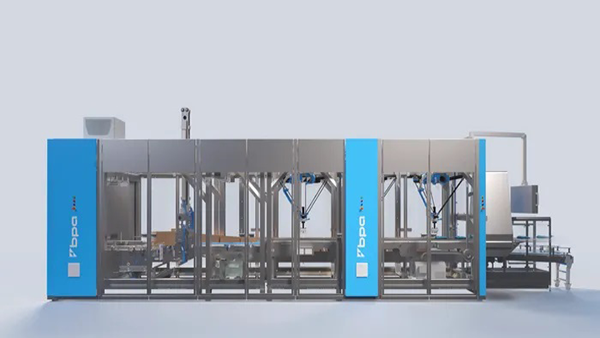
New Trends in Automated Case Packing
In food manufacturing, the final steps of the line matter just as much as the first. Case packing — loading finished products into shipping cases or cartons — has long been a labor-intensive bottleneck. Today, that’s changing fast.
Labor shortages, rising costs, and the push for higher throughput are driving change. As a result, food manufacturers are embracing a new generation of automated case packing technologies. From collaborative robots to AI-guided vision systems, the automated case packer of 2026 is smarter, faster, and far more adaptable than before.
1. Robotic Case Packers with Adaptive Grippers
Traditional case packing machines were rigid. Built for one product, one format, one speed. The new wave of robotic case packers breaks that mold entirely.
Equipped with adaptive end-of-arm tooling (EOAT), these systems handle a wide range of product shapes, sizes, and weights without lengthy changeovers. Soft pneumatic grippers and vacuum-based suction tools can now gently handle fragile items — eggs, glass jars, fresh bakery products — at speeds that once required dedicated hard automation. Because of this flexibility, manufacturers can switch between SKUs in minutes instead of hours.
What makes them different:
- Multi-format handling — one robot, dozens of product types
- Automatic tool-change systems that swap grippers between runs
- Force-sensing technology that prevents product damage during pick-and-place
- Speeds exceeding 120 picks per minute on high-volume lines
2. Vision-Guided Quality Control in Case Packing
Automated case packing isn’t just about speed anymore. It’s about accuracy and quality assurance built into every cycle. Machine vision systems, powered by deep learning models trained on millions of product images, are now embedded directly into case packing lines.
These systems inspect every item before it enters the case. They check for damaged packaging, incorrect labels, missing items, or improper orientation. Rejected products are automatically diverted without stopping the line, and every inspection event is logged for traceability. For food companies facing strict retail compliance rules, this level of in-line quality control changes the game.
3. Mixed-SKU Case Packing for Omnichannel Fulfillment
E-commerce and direct-to-consumer food delivery have created a new challenge: mixed-case packing. Instead of packing one product type per case, modern fulfillment operations increasingly need cases with multiple SKUs — think a curated snack box or a weekly meal kit.
AI-powered robotic systems now handle this complexity with ease. Using real-time order data, the system sequences picks from multiple product streams and assembles mixed cases with precise placement. This keeps products packed efficiently and undamaged. What once required manual labor is now automated at scale.
Industries benefiting most:
- Meal kit and subscription box services
- Specialty and artisan food brands with diverse SKU ranges
- Retail-ready promotional packs and seasonal gift collections
- E-commerce grocery fulfillment centers
4. Collaborative Robots (Cobots) on the Packing Line
Not every food manufacturer is ready for full-line hard automation. Collaborative robots, or cobots, offer a compelling middle ground. They work safely alongside human operators without safety caging. Because of this, cobots can slot onto existing packing lines to handle repetitive, ergonomically demanding tasks like case loading, lid placement, and carton erecting.
The latest cobots feature tool-free setup and intuitive teach-by-demonstration programming. Built-in safety systems make them accessible even to manufacturers with limited automation experience. As a result, return-on-investment timelines have fallen sharply — many deployments now break even in under 18 months.
5. Sustainable Case Packing and Material Optimization
Sustainability is reshaping packaging design, and automated case packing is adapting to keep pace. Food brands are shifting toward lighter-weight corrugated materials, recycled content cartons, and smaller packaging footprints. So, their case packing equipment has to evolve too.
Modern automated case packers now handle a wider range of case constructions — wrap-around, top-load, and side-load — all from a single configurable machine. Software-driven case geometry tools calculate the ideal case size and packing pattern for each product. This minimizes material use while maximizing pallet density. The result: less cardboard, lower freight costs, and a smaller carbon footprint.
6. Seamless Integration with MES and ERP Systems
The automated case packer of 2026 doesn’t operate in isolation. It’s a connected node in a broader digital manufacturing ecosystem. Integration with Manufacturing Execution Systems (MES) and Enterprise Resource Planning (ERP) platforms lets case packing lines receive real-time production orders, update inventory automatically, and flag exceptions without human intervention.
This connectivity enables dynamic line scheduling. The system adjusts automatically to priority orders, short runs, or last-minute customer changes — no manual reprogramming needed. It also generates the digital traceability records that major retailers and regulators increasingly require.
The Road Ahead
Automated case packing trends are reaching an inflection point. What was once limited to high-volume commodity producers is now within reach of mid-size manufacturers, specialty brands, and co-packers of every scale. Robot costs keep falling, and software keeps growing more powerful. Because of this, the barriers to entry keep dropping too.
For manufacturers still relying heavily on manual case packing, the question isn’t whether to automate — it’s how quickly to begin. The companies investing today in flexible, intelligent case packing automation will set the pace for the rest of the decade.